
The Department of Computer Science & Engineering at Rajadhani Institute of Engineering & Technology (RIET) was established in 2009 with the vision of providing high-quality education and training in the rapidly evolving fields of computer science and technology. The department initially began with an intake capacity of 60 students and has since expanded to meet the growing demand for skilled professionals in the tech industry.
Key milestones in the department’s growth:
- 2009: Establishment of the Computer Science & Engineering department.
- 2020: Introduction of the Cyber Security program, with an intake capacity of 60 students. This program was designed to address the increasing need for experts in protecting digital systems and data from cyber threats.
- 2023: Launch of the Artificial Intelligence & Machine Learning (AI & ML) program, with an intake of 60 students. This program aims to equip students with the knowledge and skills required in the cutting-edge areas of AI, ML, and Data science.
- 2024: The intake for the Computer Science & Engineering program was increased to 120 students.
- 2025: The intake for the Computer Science & Engineering program was further increased to 180 students, reflecting the continued growth in demand for computing education.
The department’s growth in both academic offerings and intake reflects its dedication to preparing students for the challenges and opportunities in the ever-changing landscape of computer science and technology.
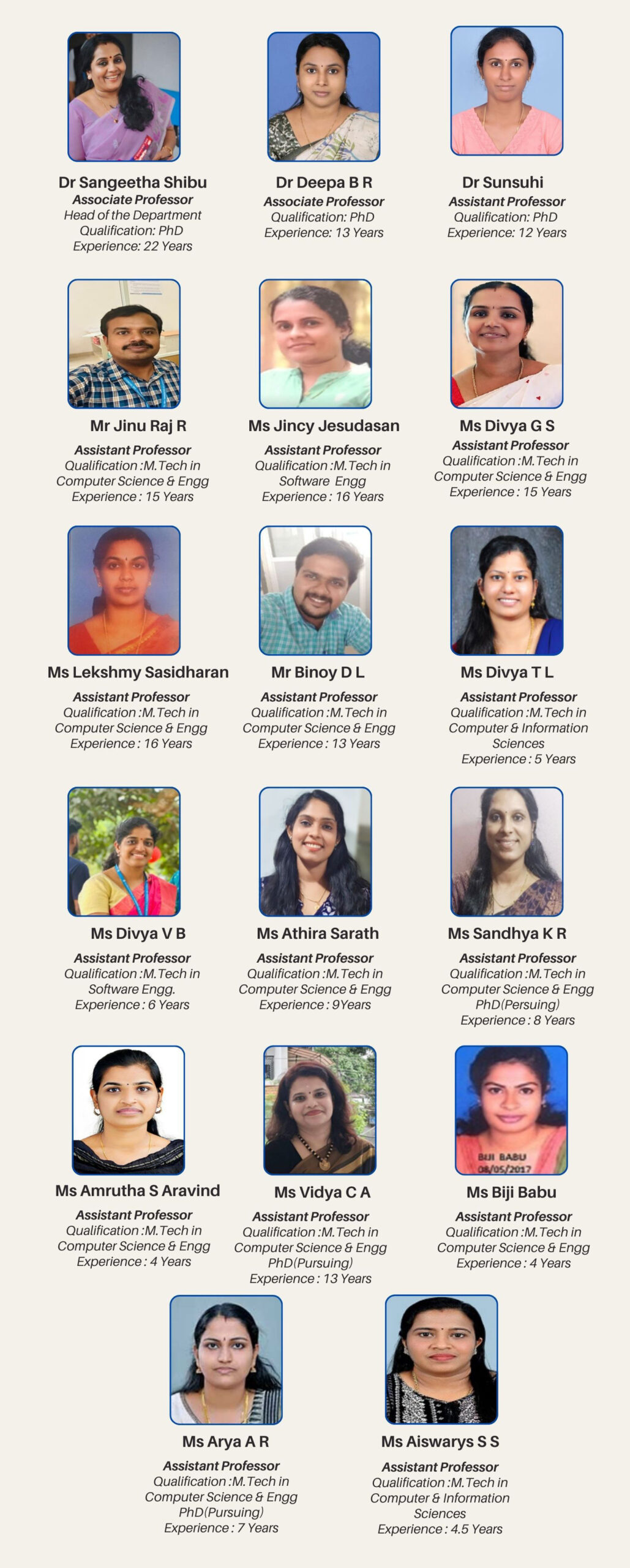
The department has grown steadily over the years, maintaining a strong academic reputation, and producing skilled professionals who excel in both the industry and academia. The department has dedicated, qualified and experienced faculty members to guide the students in academics.
The department is equipped with state-of-the-art laboratories and computing resources to support the academic and research needs of students. Our labs are designed to provide hands-on experience with modern software tools, programming languages, and hardware systems. We also have high-speed internet access, multimedia classrooms, and dedicated spaces for collaborative work and innovation.
Vision of the Institute
Groom the Youth as Innovative, Creative and Empathetic Technologists, Hospitality Professionals, Managers and Entrepreneurs for Social Transformation
Mission of the Institute
M1: To encourage holistic development of students with well balanced curricular, co-curricular and extra-curricular activities.
M2: To promote ethical and value-oriented teaching, research and consultancy among faculty and students for social transformation.
M3: To interact with industrial organizations, governmental agencies, and engineering, hospitality and business enterprises for collaborative learning
Vision of the Department
To be a premier department nurturing students to be strong in core and interdisciplinary knowledge, employable skills, industrially competent ,innovative and creative professionals with ethical values
Mission of the Department
M1 :To develop competency in Computer Science & Engineering through outcome based education
M2 :To imbibe the culture of creativity and critical thinking to enhance research and innovations in advanced computing technology.
M3;To enhance leadership, problem solving and entrepreneurial skills to transform social responsibilities with ethical values
Sl | UG Program | Intake |
1 | B.Tech Computer Science & Engineering | 180 |
2 | B.Tech Computer Science & Engineering(Cyber Security) | 60 |
3 | B.Tech Computer Science & Engineering (Artificial Intelligence & Machine Learning) | 60 |
- Computer Science and Engineering is a branch of engineering that applies principles of computation, mathematics, and logic to design, develop, test, and analyze software systems, algorithms, and computing hardware.
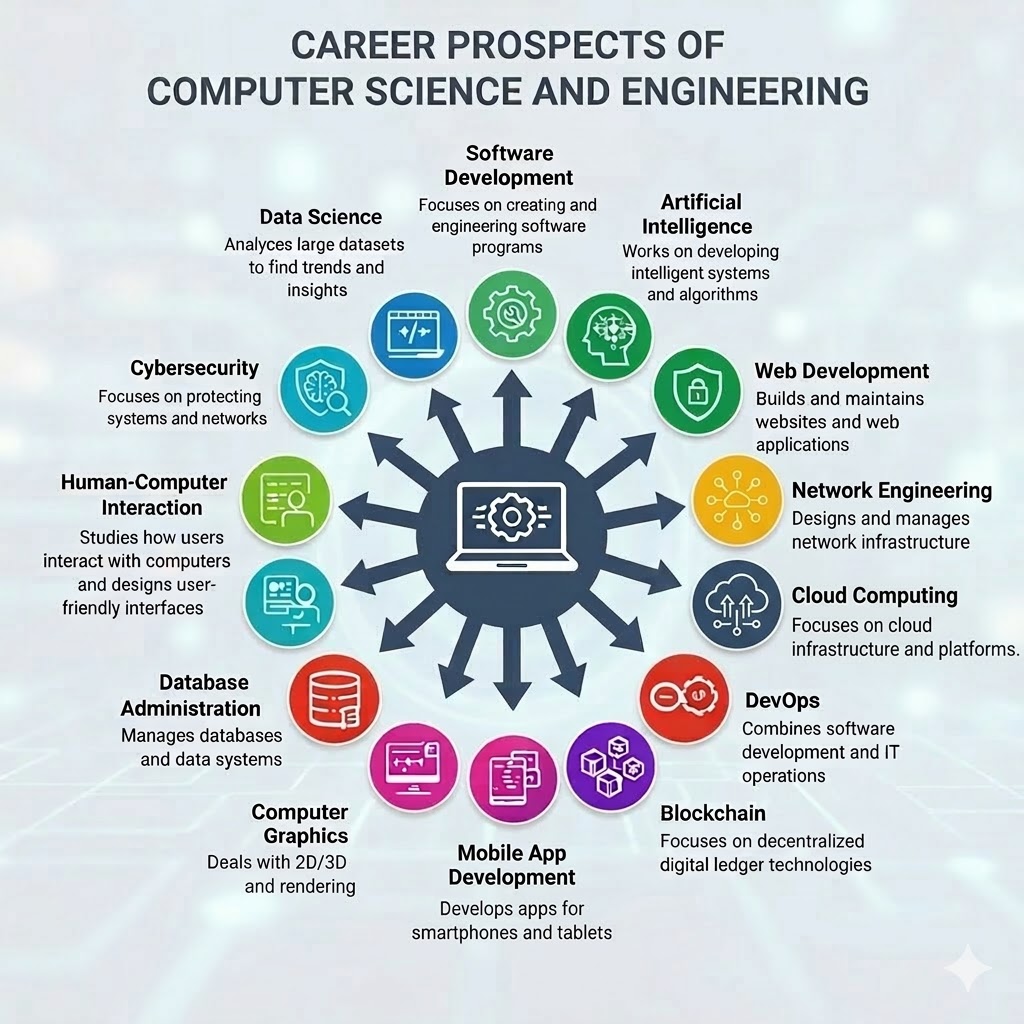
- Computer Science and Engineering offers a diverse range of career opportunities that span from software development and system architecture to artificial intelligence, machine learning, data science, cybersecurity, cloud computing, and Internet of Things (IoT) applications.
- Computer Science and Engineering graduates excel in job roles like Software Engineer, Full Stack Developer, Data Scientist, Systems Architect, Cybersecurity Analyst, AI/ML Engineer, and Database Administrator.
- In addition to the ample number of opportunities abroad, they have a plenty of career opportunities in India in the private tech sector and government sector organisations like ISRO, DRDO, NIC (National Informatics Centre), NITI Aayog, IITs and IIITs, PSUs (Public Sector Undertakings), and so on.
- For computer science engineers seeking to enhance their skills or broaden their career paths, numerous additional courses and certifications are available, ranging from Cloud Certifications (AWS, Azure, GCP), Data Science and AI specializations, Full-Stack Web Development bootcamps, Cybersecurity certifications (CISSP, CEH), and advanced degree programs like an M.Tech or an MBA.
|
JOURNALS/CONFERENCES/BOOKS CHAPTERS/ARTICLES |
||||
|
SL.No |
NAME OF FACULTY |
PAPER TITLE |
NAME |
YEAR |
|
1 |
SANGEETHA SHIBU |
Physical link quality metrics-based stable routine for QOS enhancement in ad hoc network . |
Applied Nanoscience, Springer |
2022 |
|
2 |
AMITHA K A |
A Solid Waste Management System Using Smart Bins in a Decentralized Manner in Ethereum Blockchain network for incentivization |
IEEE (ICCSC -International conference on Computational system and Communication ) |
2023 |
|
3 |
AMRUTHA S ARAVIND |
Traffic Forecasting with Graph Convolutional Network and Gated Recurrent Unit using Internal and External Factors in Different Domains |
International Journal of Science and Research (IJSR) |
2023 |
|
4 |
JINU RAJ R |
Fuzzy Thresholding based Image Warping Technique to Implement Real Time Virtual Try-On on Person’s 2D Image |
International conference on Artificial Intelligence & Information Technology (ICAIIT) |
2023 |
|
5 |
VIDYA |
Systematic Review on Deep Learning-Based Heart Disease Diagonosis |
International Conference on Edge Computing & Applications ISBN : 979-8-3503-4757-9 |
2023 |
|
6 |
Dr SANGEETHA SHIBU |
Energy Efficient Spectrum Sensing Through Cellular Automata in Cognitive Radio For 5G Networks |
Nanotechnology Perceptions (ISSN 16660-6795 |
2024 |
|
7 |
BINOY D L |
Cyberbullying Identification in Social Media: A Comparison of transfer learning & Machine Learning Methods |
International Conference on signal processing, Instrumentation & Communication Engineering (ISBN : 978-93-340-1119-7 |
2024 |



Programming Lab I

Configuration: Intel Core i3 with 8 GB RAM, 512GB NVMA, 19.5 inches Display
Count: 44
This lab is designed to facilitate hands-on learning and practical implementation of programming concepts. It serves as a hub for conducting Data Structures, C Programming, and Python Labs, providing students with a robust environment to develop problem-solving skills and master essential coding techniques. Equipped with modern computing resources and guided by expert faculty, the lab empowers learners to build a strong foundation in programming and algorithm design.
Programming Lab II

Configuration : Intel Core i3 with 8 GB RAM, 512GB NVMA, 19,5 inch Display
Count : 60
This lab is designed to facilitate hands-on learning and practical implementation of core concepts in Database Management Systems (DBMS) and Network Programming. Equipped with advanced computing resources and the latest software tools, it enables students to design, develop, and manage databases efficiently while also exploring the intricacies of network protocols, socket programming, and distributed systems. This lab serves as a hub for fostering technical expertise and problem-solving skills, preparing students for real-world challenges in database management and networking domains.
Programming Lab III

Configuration : Intel Core i3 with 8 GB RAM, 512GB NVMA, 19.5 inch Display
Count : 100
The Laboratory is a well-equipped computing facility dedicated to strengthening the practical programming skills of students across multiple domains. This lab serves as a hands-on learning environment where students gain in-depth experience in C Programming, Python Programming, and IT workshops, complementing their theoretical coursework with real-world problem solving.
In addition to regular academic sessions, the lab hosts IT workshops, skill-development programs, and hands-on training activities that expose students to emerging technologies and industry practices
SDPK Lab

Configuration : Intel Core i3 with 8 GB RAM, 512GB NVMA, 19.5 inch Display
Count : 60
This lab serves as a hub for conducting Java Programming practical sessions, fostering hands-on learning and skill development. Equipped with Cisco Webex video conferencing technology, the lab enables seamless global connectivity, facilitating interactive two-way communication between students and experts from around the world. This advanced setup ensures an enriched learning environment, bridging geographical boundaries and providing students with invaluable exposure to real-world collaborations and knowledge exchange.
Project Laboratory

Configuration :
iMac Core i7 with 8 GB RAM ,1 TB HDD , 21inch Display
Count: 11
Intel Core i5 with 4 GB RAM, 500 GB HDD 18.5 inch Display
Count : 16
Intel Core i5 with 16 GB RAM, 1TB SSD 20 inch Display, Asus RTX 3050 6GB DDR6 Graphics Card
Count : 6
The Project Laboratory is a dedicated innovation space where students design, develop, and implement their academic projects across diverse domains of Computer Science and Engineering. The lab provides a professional, industry-oriented environment that enables students to transform theoretical knowledge into practical solutions through hands-on project development supports hands-on learning, enabling participants to gain practical expertise and stay ahead in the ever-evolving world of Apple technologies.
The facility is equipped with Apple iMac systems along with high-performance workstations featuring advanced processors and GPU support. These computing resources enable students to efficiently develop compute-intensive applications, particularly in areas such as Artificial Intelligence, Machine Learning, Data Science, Computer Vision, and Deep Learning.
To support interdisciplinary innovation, the Project Laboratory also integrates an IoT (Internet of Things) Lab, enabling students to design and implement hardware-software integrated solutions. With access to sensors, microcontrollers, embedded platforms, and networking tools, students can develop real-world IoT applications such as smart automation systems, environmental monitoring solutions, and intelligent devices.


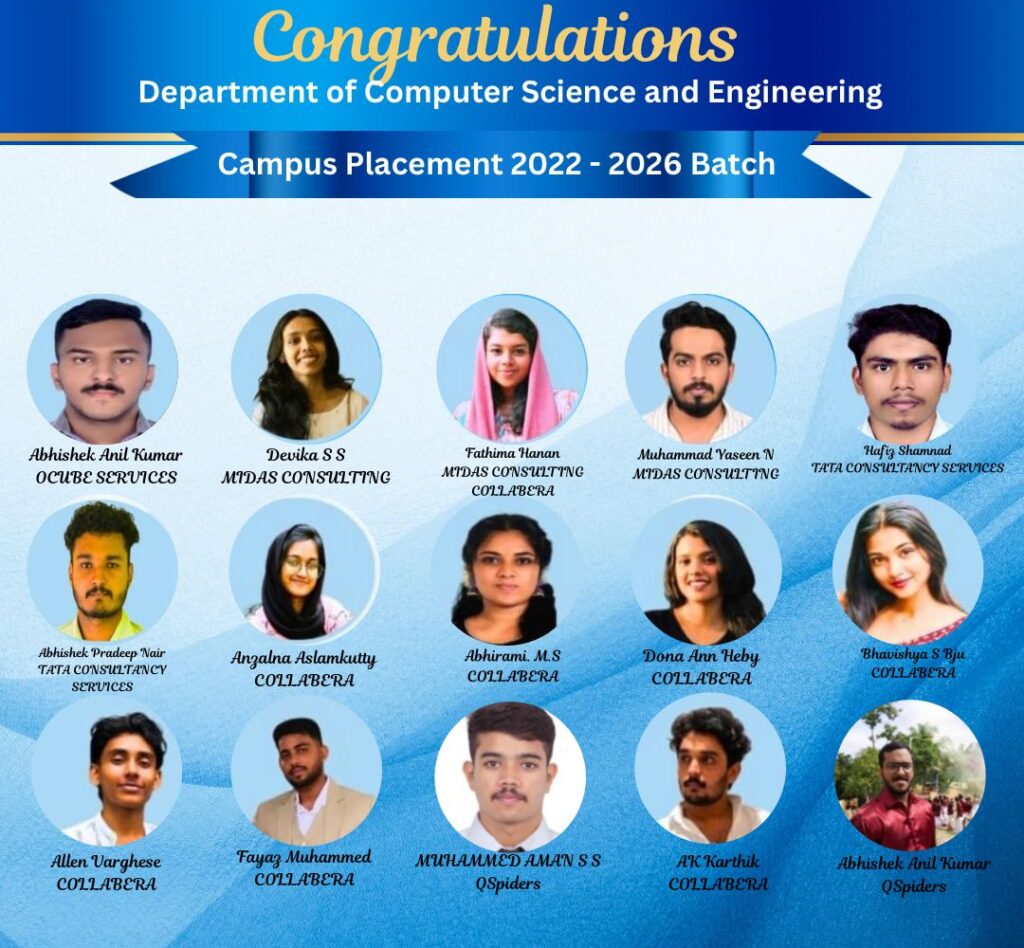
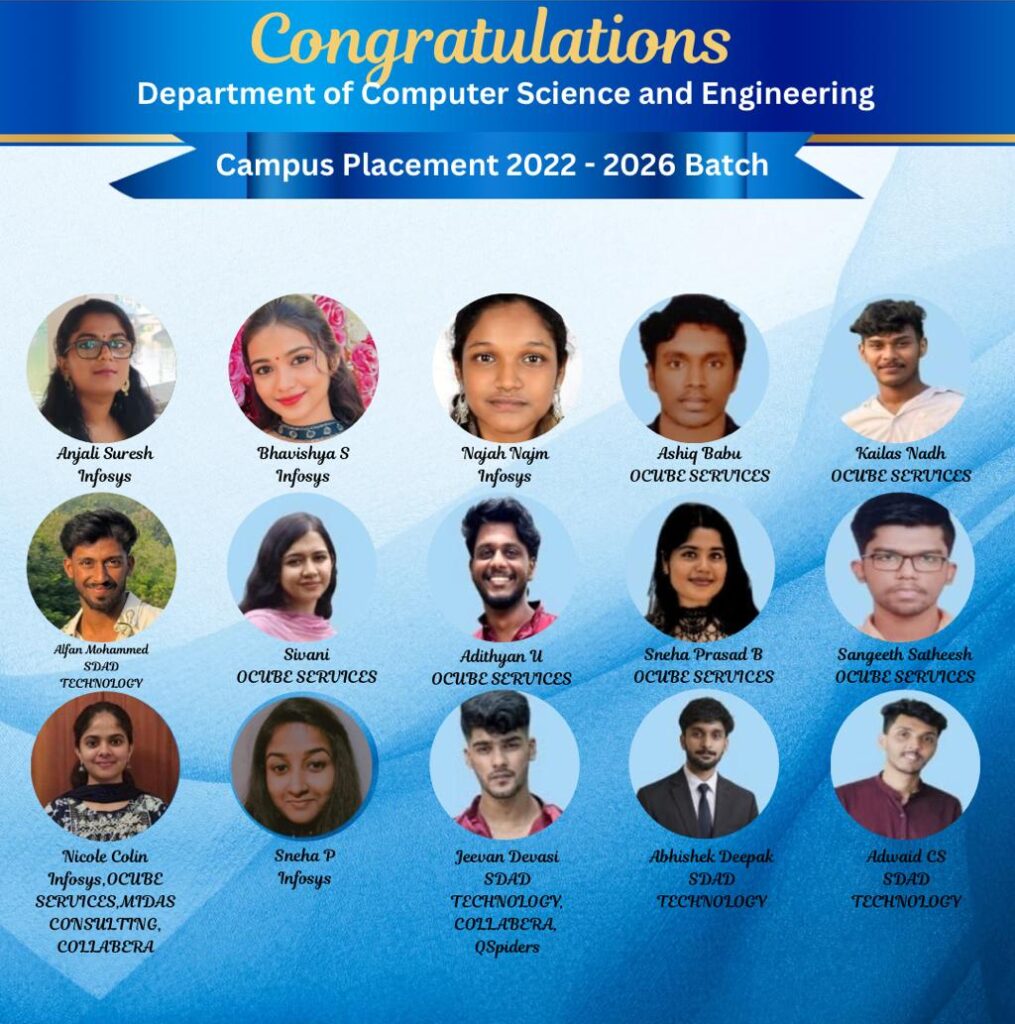
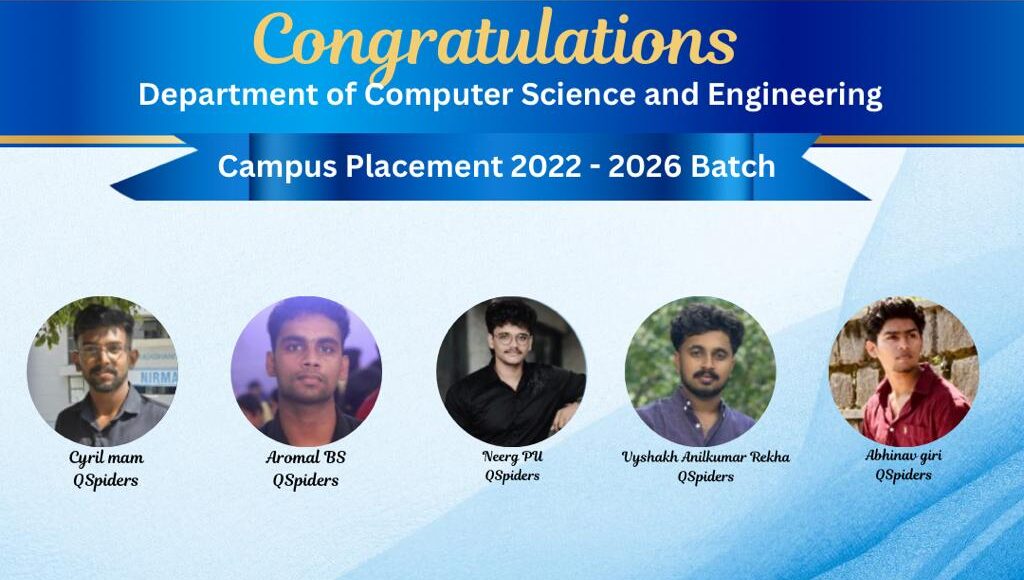
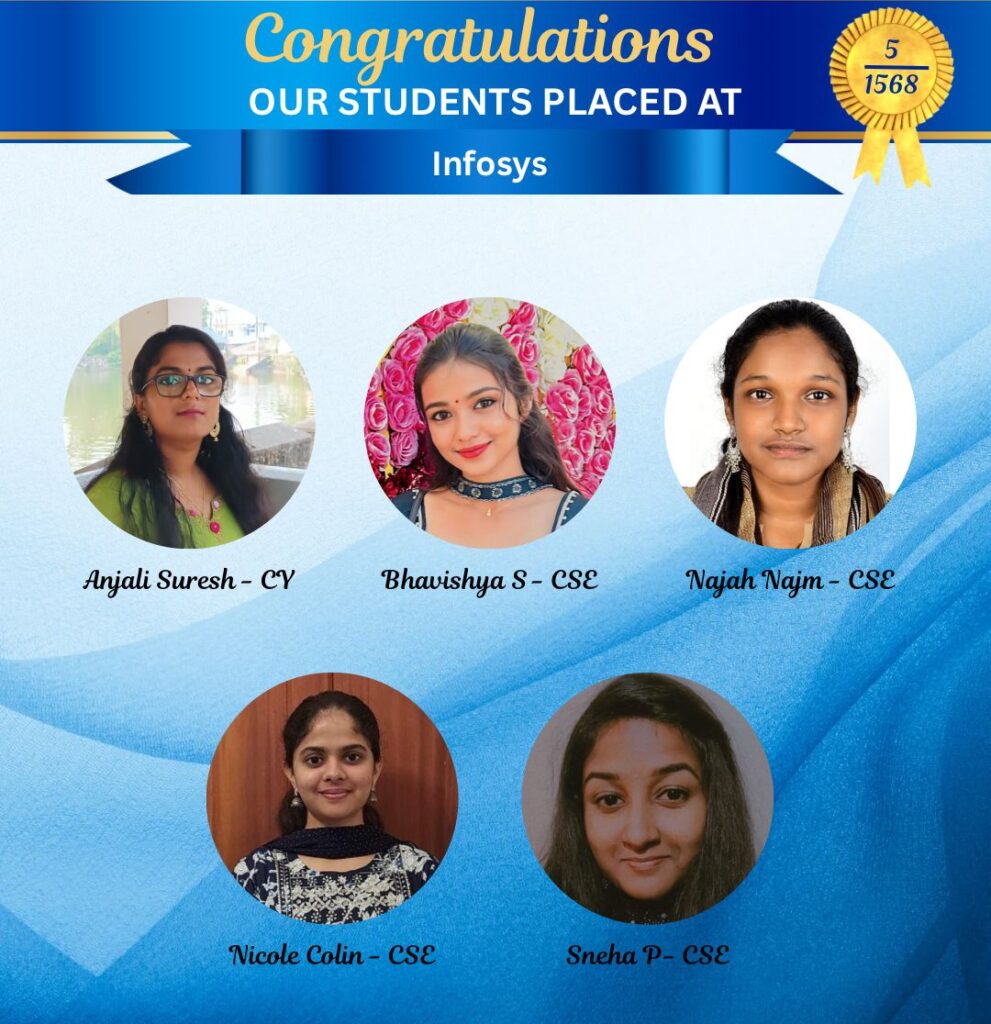
| Batch : 2020-2024 | ||||
| Sl No | Reg No | Student Name | Designation & Placed with Company Details | Remarks |
| 1 | RIE20CS052 | Shivajee N | Poornam Info Vision-Junior Software Trainee | |
| Software Engineer, Six Dee Telecom Solutions | ||||
| 2 | RIE20CS009 | Ajmal Sajeev | Maxwin – Business Development Manager | |
| 3 | RIE20CS049 | Sarin Krishnan | QSpider- Trainee | |
| 4 | RIE20CS022 | B.S. Meenakshi | ESAF Bank – Customer Service Executive | |
| 5 | RIE20CS034 | Jino Ajayan | Qspider- Trainee | |
| Infowise | ||||
| 6 | RIE20CS050 | Shahin M Hashim | Qspider- Trainee | |
| 7 | RIE20CS038 | Manesh Mohan | Qspider- Trainee | |
| 8 | RIE20CS010 | Akash M Kumar | Cofount Labs – Frontend Developer | |
| 9 | RIE20CS023 | Deepika S R | Product Intern | |
| Prepared by | HOD | |||
| Batch : 2021-2025 | ||||||
| Sl No | Reg No | Student Name | Contact Number | Designation & Placed with Company Details | Package | Remarks |
| 1 | RIE21CS005 | ABHIRAM R S | 9048941734 | Associate, Sutherland | 2.65 Lpa | |
| 2 | RIE21CS009 | ADHINAN THAHIR | 8848311668 | Associate, Sutherland | 2.65 Lpa | |
| 3 | RIE21CS012 | AKHIL SANTHOSH | 9495539510 | Associate, Sutherland | 2.65 Lpa | |
| 4 | RIE21CS015 | ANUPA SUSAN CHACKO | 8590442231 | Associate, Sutherland | 2.65 Lpa | |
| 5 | RIE21CS019 | ASHWIN ANIL ABRAHAM | 8078127018 | Associate, Sutherland | 2.65 Lpa | |
| 6 | RIE21CS022 | BENCY S | 7012821769 | Associate, Sutherland | 2.65 Lpa | |
| 7 | RIE21CS024 | CHRISTO SABU | 7560993969 | Associate, Sutherland | 2.65 Lpa | |
| 8 | RIE21CS029 | GOKUL PANKAJ R V | 8943270561 | Associate, Sutherland | 2.65 Lpa | |
| 9 | RIE21CS030 | GOPIKA S | 9846670154 | Associate, Sutherland | 2.65 Lpa | |
| 10 | RIE21CS046 | PRANAV J | 9447550512 | Associate, Sutherland | 2.65 Lpa | |
| 11 | RIE21CS036 | MOHAMMED ANAZ N | 9562005851 | Associate, Sutherland | 2.65 Lpa | |
| 12 | RIE21CS042 | NIMMI ABDUL NAZIR | 7994232662 | Associate, Sutherland | 2.65 Lpa | |
| 13 | RIE21CS043 | NIYAS MOHAMMED NOWSHAD | 8111871155 | Associate, Sutherland | 2.65 Lpa | |
| 14 | RIE21CS050 | SIVADEV V | 9605873327 | Associate, Sutherland | 2.65 Lpa | |
| 15 | RIE21CS053 | TEVIN JIJI THOMAS | 9846756609 | Associate, Sutherland | 2.65 Lpa | |
| 16 | RIE21CS059 | ZAYED SAVAD | 8606001688 | Associate, Sutherland | 2.65 Lpa | |
| Faculty in Charge | HOD | |||||
| Batch : 2020-2024 | |||||
| Sl No | Reg No | Student Name | Designation & Placed with Company Details | Package | Remarks |
| 1 | RIE20CC030 | Nived Manoharan | Assistant System Engineer – Trainee, Tata Consultancy Services | 3.36 lpa | |
| Junior Software Trainee, Poornam Info Vision | |||||
| 2 | RIE20CC023 | Indrajith M | Assistant System Engineer – Trainee, Tata Consultancy Services | 3.36 lpa | |
| 3 | RIE20CC039 | Sivdev S | Mitsogo Technologies | 4 lpa | |
| 4 | RIE20CC027 | Megha S | STEM Robotics Instructor, Techosa Edu Solutions | 2 lpa | |
| 5 | RIE20CC018 | Devanandana | STEM Robotics Instructor, Techosa Edu Solutions | 2 lpa | |
| 6 | RIE20CC028 | Minshad J Naisam | Trainee – QSpider | ||
| Infowise | |||||
| 7 | RIE20CC001 | Aadhil Shah | Infowise | ||
| 8 | RIE20CC006 | Alfiya S | Infowise | ||
| 9 | RIE20CC004 | Adithya Raj K R | Infowise | ||
| 10 | RIE20CC009 | Anakha M | Infowise | ||
| 11 | RIE20CC029 | Nandakishor P | Infowise | ||
| 12 | RIE20CC035 | Sandeep Jagan | Infowise | ||
| 13 | RIE20CC005 | Afzal Ajeeth | Infowise | ||
| 14 | RIE20CC033 | Rispa Anil Thomas | Infowise | ||
| 15 | RIE20CC041 | Sooraj Baiju | Infowise | ||
| 16 | RIE20CC002 | Abhay AL | Infowise | ||
| 17 | RIE20CC022 | Govind S | Infowise | ||
| 18 | RIE20CC038 | Sidharth S | Executive, ESAF | ||
| Prepared by | HOD | ||||
| Batch : 2021-2025 | ||||||
| Sl No | Reg No | Student Name | Contact Number | Designation & Placed with Company Details | Package | Remarks |
| 1 | RIE21CC018 | ANUSJYOTHI | 6238763066 | Associate, Sutherland | 2.65 Lpa | |
| 2 | RIE21CC021 | ASWATHY P S | 8921024612 | Associate, Sutherland | 2.65 Lpa | |
| 3 | RIE21CC029 | GOWRINANDHA G B | 8075810288 | Associate, Sutherland | 2.65 Lpa | |
| 4 | RIE21CC045 | NEHA SUNIL LAL | 9995464858 | Associate, Sutherland | 2.65 Lpa | |
| 5 | RIE21CC025 | C B VISHAK | 9072702324 | Associate, Sutherland | 2.65 Lpa | |
| Faculty in Charge | HOD | |||||


The Department of Computer Science & Engineering is committed to providing students with valuable industry exposure, bridging the gap between academic learning and real-world applications. As part of our efforts to enhance students’ practical knowledge, we organize regular industrial visits to leading IT companies.
These visits offer students a unique opportunity to observe the latest technological advancements, understand industry trends, and interact with professionals working in the field. By experiencing the work culture, processes, and innovations firsthand, students gain insights that complement their classroom education and help them stay ahead in an ever-evolving tech landscape.
Infosys , Trivandrum Campus
The Department of Computer Science and Engineering organized a one-day industrial visit for first-year students to Infosys Trivandrum. The visit provided students with an invaluable opportunity to explore the world of technology in a leading IT company, gaining practical insights into the industry.

UST Global, Trivandrum
The Department of Computer Science and Engineering organized a one-day industrial visit for first-year students to UST global Trivandrum. This visit provided a unique opportunity for students at different stages of their academic journey to witness firsthand the cutting-edge technologies and industry practices shaping the IT sector.


Innovations by the Faculty in Teaching and Learning
The Department of Computer Science and Engineering uses the Learning Management System – Linways AMS to manage and monitor all academic activities effectively. The curriculum is designed by incorporating several innovative initiatives aimed at improving the overall quality of the teaching–learning process. The adoption of innovative teaching methods not only strengthens the educational process but also contributes to the holistic development of students.
Various innovative practices are integrated into the teaching and learning process to encourage students’ curiosity and interest in different areas of computing and technology. These approaches motivate students to question existing ideas, explore new concepts, and develop analytical and problem-solving skills. Techniques such as coding practices, project-based learning, collaborative learning, case studies, and online assessments are used to make the learning process more interactive and practical.
The continuous implementation of these innovative methods helps students develop teamwork, ethical values, and a sense of social responsibility. It also promotes knowledge sharing and collaborative learning among students. The effectiveness of these methods is evident through both qualitative and quantitative outcomes. Qualitatively, these practices enhance students’ understanding, communication skills, and social behavior. Quantitatively, they contribute to improved academic performance and better achievement of learning outcomes.
Faculty members of the Department of Computer Science and Engineering actively implement various innovative and best teaching practices to enhance student engagement, encourage critical thinking, and improve the overall learning experience.
Pedagogical Methods
Lecture with PowerPoint Presentation
A lecture using a PowerPoint presentation is a modern and effective teaching method that combines verbal explanation with visual aids. In this method, the teacher presents information through slides while explaining the content to students. PowerPoint helps organize the lecture in a systematic and engaging manner.
At the beginning of the lecture, the topic and objectives are introduced through the initial slides. Each slide highlights key points, definitions, images, charts, or diagrams, which helps students understand the subject more easily. The use of visuals enhances clarity and maintains students’ attention throughout the lecture.
PowerPoint presentations allow complex concepts to be explained in a simplified way. Animations, bullet points, and examples help break down information into manageable parts. This method also saves time, as large amounts of information can be presented clearly without lengthy writing on the board.
Interaction can be encouraged by asking questions related to the slides, discussing examples shown, or pausing the presentation to clarify doubts. Teachers can also include videos or real-life examples to make the lecture more interesting and relatable.
Overall, a lecture using a PowerPoint presentation improves communication, enhances understanding, and supports effective learning by combining spoken explanation with visual representation.

Lecture with Discussion
A lecture with discussion is an interactive teaching method that combines explanation by the teacher with active participation from students. In this method, the teacher presents the topic and explains the main concepts while encouraging students to share their ideas, opinions, and questions during the lecture.
At the beginning of the lecture, the teacher introduces the topic and outlines the objectives. After explaining each major point, the teacher initiates discussion by asking questions or presenting problems related to the topic. This allows students to think critically and express their understanding.
Discussion helps clarify doubts, deepen understanding, and promote active learning. Students learn not only from the teacher but also from their peers by listening to different perspectives. The teacher acts as a facilitator, guiding the discussion and keeping it focused on the topic.
A lecture with discussion improves communication skills, critical thinking, and student engagement. It creates a learner-centered environment where students are actively involved, making the learning process more effective and meaningful.

Lecture with Video Content
A lecture with video content is a teaching method that combines verbal explanation with audio-visual materials to enhance learning. In this method, the teacher uses videos to support and illustrate the concepts being taught during the lecture.
At the beginning of the lecture, the teacher introduces the topic and explains the learning objectives. Relevant video clips are then shown to demonstrate real-life examples, processes, experiments, or case studies related to the subject. This helps students visualize concepts that may be difficult to understand through explanation alone.
The teacher pauses the video at important points to explain key ideas, ask questions, and encourage student interaction. Discussion after the video helps students reflect on what they have seen and clarify doubts. Videos also help maintain students’ attention and improve understanding and retention.
Overall, a lecture with video content makes learning more engaging, interactive, and effective by combining explanation with visual and auditory learning experiences.

Lecture with Demonstration
A lecture with demonstration is a teaching method in which the teacher explains a concept and simultaneously shows how it works through practical demonstration. This method helps students understand both the theory and its application.
At the beginning of the lecture, the teacher introduces the topic and explains the objectives. While explaining the concept, the teacher demonstrates the process using models, experiments, tools, charts, or real objects. This allows students to observe the steps and understand the concept clearly.
Demonstration helps in better understanding, especially for practical and scientific subjects. Students can see the actual working of a process, which improves interest and retention. The teacher may also involve students in the demonstration to increase participation.
Overall, a lecture with demonstration makes learning more effective by connecting theoretical knowledge with practical experience and encouraging active learning.

Hands on Training
Hands-on training is a practical method of teaching and learning in which students actively perform tasks or activities to understand concepts better. It enables students to apply the theoretical knowledge gained in the classroom to real-world situations through direct practical experience.
In hands-on training, the instructor first explains the objective of the activity, the required tools or resources, and the procedure to be followed. Students then perform the activity by observing, practicing, and recording their results under proper guidance and safety measures. This process helps students develop accuracy, confidence, and discipline.
Hands-on training helps students develop important skills such as observation, experimentation, analysis, and problem-solving. It also encourages curiosity, independent learning, and teamwork among students.
Overall, hands-on training plays a significant role in effective learning by strengthening conceptual understanding and enhancing practical skills.

Problem Solving
Problem solving is an important teaching–learning method that helps students develop critical thinking and reasoning skills. It involves identifying a problem, understanding it clearly, and finding an appropriate solution using knowledge, logic, and experience.
In this method, the teacher presents a problem related to the topic and guides students to analyze it step by step. Students think about possible solutions, apply relevant concepts or formulas, and arrive at the correct answer. The teacher supports and corrects students when necessary.
Problem solving encourages active learning, independent thinking, and creativity. It helps students apply theoretical knowledge to practical situations and improves their confidence in handling real-life problems.
Overall, problem solving is an effective learning method that enhances understanding, analytical ability, and decision-making skills.
Tutorial Classes
Tutorial classes are small-group teaching sessions designed to provide additional academic support to students. They help reinforce concepts taught during regular lectures and focus on clearing doubts and improving understanding.
In tutorial classes, the teacher interacts closely with students, discusses difficult topics, and encourages questions. Students are given exercises, problems, or assignments to practice, and individual attention is provided to help them overcome learning difficulties.
Tutorial classes promote active participation, better teacher–student interaction, and personalized learning. They also help students improve problem-solving skills and academic performance.
Overall, tutorial classes play an important role in strengthening learning by offering guidance, practice, and clarification beyond classroom lectures.
Other various Instructional Methods
Sl No | Title | Link for various instructional materials |
1 | Linways Academic Management System | |
2 | DELNET | |
3 | J-GATE | |
4 | National Digital Library (NDL) |
Youtube Channels of faculty members
S. o | Name of the Faculty | Name of the Subject | URL | Subscribers | Viewers |
1. | Mr.Jinuraj R | Computer Network | https://youtu.be/DxCWde5v4rE?feature=shared
| 1.94K | 10k |
2. | Mr.Jinuraj R | Logic System Design | https://youtu.be/Xji2j4i5lNw?feature=shared
| 1.9k | 11k |
3. | Mr.Jinuraj R | Data Base Management System | https://youtu.be/3-qZzh8YSRc?feature=shared
| 1.9 | 4.9k |
4. | Mrs.Athira Sarath | Programming in Python | https://youtu.be/Z8ojfUWO8mM?feature=shared
| 32 | 43 |
5. | Mrs.Divya G S | Artificial Intelligence | https://youtu.be/8rHNwoKpi0A?feature=shared
| 41 | 28 |
6. | Mrs.Divya G S | Computer | https://youtu.be/e7uCKPytubE?feature=shared
| 41 | 32 |
7. | Mrs.Divya G S |
Compiler | https://youtu.be/wC0JhONv2zU?feature=shared
| 41 | 87 |
8. | Mrs.Divya G S |
Graph | https://youtu.be/ZTTyXE_z5Ug?feature=shared
| 41 | 38 |
9. | Mrs.Divya G S |
Embedded | https://youtu.be/wISkzK1BoFE?feature=shared
| 41 | 42 |
10. | Mrs.Divya G S |
Machine | https://youtu.be/lKELcyVlGz8?feature=shared
| 41 | 43 |
11. | Mrs.Sandhya K R | Data Base | https://youtu.be/EdpKgNGwISk?si=JkaR0My-Y9irNDpj
| 26 | 22 |
Linways AMS System

